Tool: The Parametric Shapes
Is a triangle a polygon with three sides?
Yes, obviously. And the fact that it’s obvious is why there is a separate triangle tool in this editor, which I added because an AI agent got it wrong and, in getting it wrong, showed me that I would have got it wrong too.
Here’s the story. I asked an agent to draw a house. It drew a square for the
walls, which was right, and then it needed a roof. Reaching for a triangle, and
finding a polygon primitive that takes a number of sides, it did the sensible
thing and asked for a polygon with three sides, bounded by a box sitting on top of
the square.
What it got was a triangle whose base floated above the square, with a gap of daylight underneath, and whose peak didn’t touch the top of its box either.
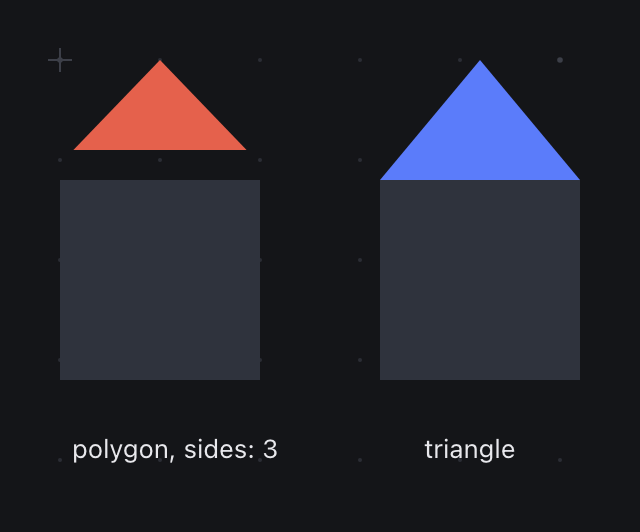
Nothing was broken. A regular polygon with N sides is defined as inscribed in a circle — every vertex on the circumference, evenly spaced. That’s what makes a hexagon a hexagon and a pentagon a pentagon, and it is what you want for every value of N you are likely to ask for. But run N=3 and look at what inscribed means: one vertex at the top of the circle, two more at 120° around it. Those two lower vertices sit at the circle’s widest points, which is above the bottom of the box. The base of an inscribed triangle does not touch the bottom edge of its bounding box. It cannot. The bottom of the box is tangent to the circle at a single point, and that point is halfway along the base, and there is no vertex there.
So the polygon tool was correct, and the agent’s reasoning was correct, and the result was a roof with a draught.
The lesson is that “a triangle is a polygon with three sides” is true in geometry and false in drawing. When a person says triangle, they don’t mean the inscribed regular 3-gon. They mean the thing with a flat base that fills its box — base on the bottom, apex at the top, corners in the corners. That’s the roof. That’s the play button. That’s the arrowhead. It is not a special case of the polygon; it’s a different shape that happens to share a vertex count.
So there’s a triangle tool, on T, and it does what people mean.
I find this a genuinely instructive kind of bug, because it’s the sort that can’t be caught by testing what you built. Both shapes were exactly right by their own definitions. The error lived in the assumption that a user reaching for “three sides” wants the mathematician’s object rather than the builder’s, and the only way I found out was by handing the tool to something that had never seen it, that read the parameter list literally, and that had no folklore telling it which primitive was really meant for roofs. [1]
The rest of the parametric shapes are what they sound like, and they earn their place by being parametric — you don’t draw them, you state them, and then you can restate them.
Polygon takes a side count. Star takes a point count. Spiral winds. Grid gives you a rectangular or polar lattice as one object rather than forty lines you have to keep aligned. Flare is a starburst. Each is a shape whose definition is a couple of numbers, and drawing them by hand would mean doing arithmetic with a pen — placing ten points of a star at exactly 36° intervals, by eye, and then living with the one that’s a degree out.
That’s the argument for a parametric primitive: not that it saves you time, but that it saves you precision you would otherwise have to fake. A star drawn by hand is a star that is slightly wrong in a way you can see but can’t locate. A star with a point count is symmetric by construction.
The moment any of them stops being enough — you want one arm of the star longer, you want the spiral to pinch — the escape hatch is to treat it as geometry: cut it, reshape it, carve it with Shape Builder. The parametric shape is a good starting point, not a cage. [2]
[1] The general form of this is worth carrying around: your users’ folklore is invisible to you, because you have it too. Anything that “everyone knows” about your tool is undocumented, and the fastest way to find it is to hand the tool to something that knows nothing and watch which of its perfectly reasonable assumptions blow up.
[2] circle is a related sleight of hand. You can ask for one, and what you get
back reports its type as ellipse, because a circle is an ellipse with equal
axes and there’s no reason for the document to carry two shapes where one will
do. The briefing tells agents this explicitly, because the first one to see it
assumed it had been given the wrong shape and drew another.